




Beautiful Blondes With Blue Eyes: Secrets of This Rare Look
The combination of blonde hair and blue eyes is a rare phenotype driven by polygenic inheritance, specifically variations in the HERC2 and OCA2 genes. This look occurs when low levels of eumelanin in the hair follicles coincide with the Tyndall effect in the iris stroma. Found naturally in only 2–3% of the global population, it is most prevalent in Northern and Eastern European ancestral lineages.
What is the Genetics of Beautiful Blondes With Blue Eyes?
This physical combination refers to individuals possessing hair with minimal eumelanin and eyes that appear blue due to structural coloration. While often called "double recessive," modern genetics shows it involves complex interactions between multiple gene markers.
The blue color in the eyes is not a pigment; it is a structural effect of light scattering in the stroma, similar to why the sky appears blue. In hair, the absence of dark pigment allows the underlying pheomelanin or light keratin to create golden, ash, or platinum tones.
Why is Beautiful Blondes With Blue Eyes important right now?
In the 2026 digital landscape, this aesthetic is highly valued for its "luminance contrast," which makes it stand out in high-definition 4K media and social platforms. The way these features reflect ambient light creates a natural focal point that thrives in modern visual marketing.
Furthermore, there is a global surge in interest regarding personalized genetics and bio-ancestry. Many individuals use these specific traits to trace their migration history from the Black Sea region to Northern Europe, making it a key topic in heritage and DNA discussions.
Read also: Perfect Skincare and Makeup Routine for Busy Students
Key benefits / features / advantages
- Optical Brightness: The low melanin content allows hair and eyes to reflect more light, creating a natural "halo" effect in photography.
- High Contrast: Blue eyes provide a sharp contrast against blonde hair, which is a rare and sought-after aesthetic in the fashion industry.
- Style Versatility: The light color palette acts as a neutral base, allowing for high-intensity fashion colors like cobalt and emerald to pop.
- Cultural Connection: It serves as a visual link to specific Northern European heritages, often sparking interest in genealogy and history.
How it works / how to use / how it helps
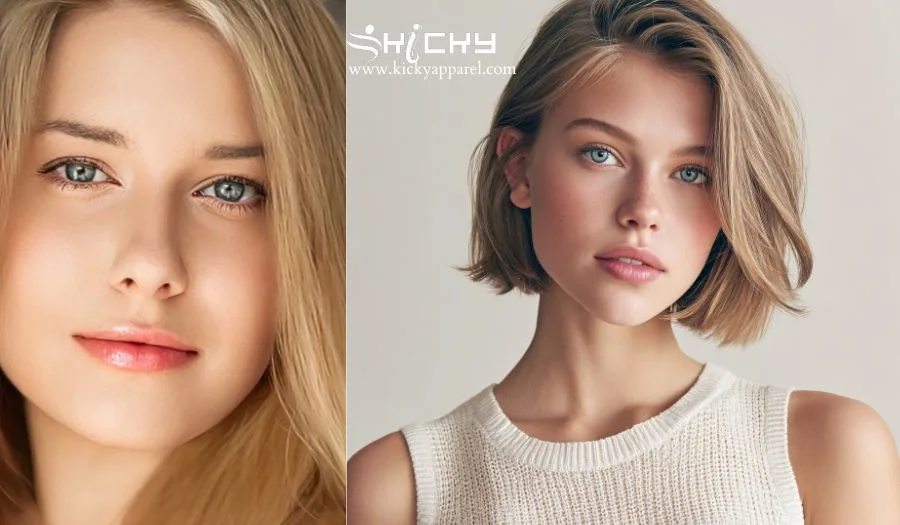
The combination functions through epistasis, where genes like HERC2 act as a switch for the OCA2 gene, controlling how much melanin is produced. For a child to display these traits, they typically inherit specific genetic "switches" that reduce pigment production in both the hair and eyes.
Understanding this biology helps in practical health management. Because these individuals have less protective pigment, they are more susceptible to photophobia (light sensitivity) and UV-induced skin damage. This knowledge empowers them to use polarized lenses and broad-spectrum SPF as essential daily tools.
Real-world examples or practical use
Icons like Margot Robbie and models from Scandinavia showcase how this look scales from "natural beachy" to "high-fashion icy." In the beauty industry, brands use these features to market skincare that focuses on "radiance" and "translucency."
On a practical level, knowing your "chroma" helps with personal branding. Cool-toned blondes (ash or platinum) often find that silver jewelry and "summer" palettes enhance their eyes, while warm-toned blondes (honey or golden) shine in "spring" tones and gold accessories.
Common mistakes or myths
A major myth is that blue eyes contain blue pigment. In reality, they are pigment-free; the color is entirely a result of light physics. Another mistake is assuming all blondes have the same skin needs; undertones vary significantly, requiring precise color matching.
Many also believe that blonde hair is a static trait. However, "Blonde hair blue eyes little girls" often experience "blonding out" or darkening, where hair turns light brown in adulthood as melanin production naturally increases with age and hormonal shifts.
Expert insights: The Tyndall Effect and OCA2
- The Tyndall Effect: Experts explain that blue eyes are an optical illusion. Light enters the pigment-free iris and scatters, reflecting only the shorter blue wavelengths back to the observer.
- Genetic Mutation: Research traces the origin of blue eyes back 6,000 to 10,000 years to a single ancestor in the Black Sea region who experienced a mutation in the HERC2 gene.
- Vitamin D Synthesis: Evolutionarily, fair skin and light hair are adaptations that helped ancestors synthesize Vitamin D more efficiently in low-light Northern climates.
Who should consider this?
This guide is essential for professional stylists, dermatologists, and genetics enthusiasts. It provides the technical depth needed to understand why certain hair dyes or skincare products react differently to low-melanin phenotypes.
It is also vital for individuals transitioning from "Natural Blondes vs. Dyed Blondes." Achieving a believable "blonde with blue eyes" look requires understanding how to balance skin translucency with hair tone to avoid a "washed out" appearance.
Read also: Simple Morning Skincare Routine for Glowing Skin
Pros and Cons
Pros:
- Striking visual presence that is highly valued in commercial modeling.
- Excellent ability to synthesize Vitamin D in northern latitudes.
- Timeless aesthetic that remains a cornerstone of beauty trends.
Cons:
- High sensitivity to sunlight and increased risk of ocular glare.
- Hair is often fine and prone to breakage or environmental staining.
- Requires consistent maintenance to prevent "brassiness" from mineral buildup.
FAQs
What is the rarest hair and eye color combination?
The rarest combination in the world is actually red hair with blue eyes, as both are highly recessive and rarely overlap.
Can two brown-eyed parents have a blonde, blue-eyed child?
Yes, if both parents carry the recessive "light" genes, they can pass them on to their child even if their own hair and eyes are dark.
Why do blue eyes look different in different lighting?
Since blue eyes rely on light scattering (the Tyndall effect) rather than pigment, the intensity and color of the ambient light directly change how the eye appears.
Final Verdict
Beautiful blondes with blue eyes are a testament to the fascinating complexity of human evolution and light physics. Beyond the striking aesthetic, this phenotype represents a unique biological adaptation. By mastering the science of color theory and UV protection, those with these rare traits can protect and enhance their natural radiance for years to come.